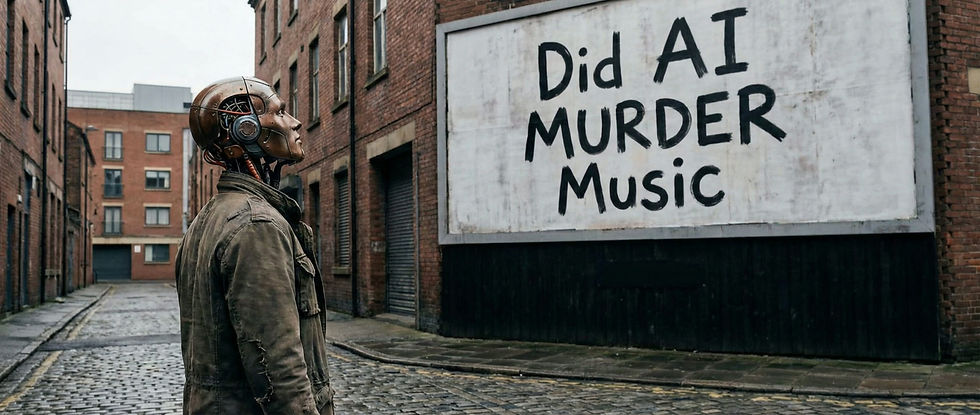
AI has caused the music world to unravel. Artists are being pushed into panic by stories meant to provoke outrage. Anger clouds judgment, fear takes hold, and once again, people cling to their fears rather than confront what truly matters. They say that AI is destroying the world of music. I believe they are telling us this for reasons unrelated to music. You see, fear sells, and if they can sell you a palm full of panic, that is what they will do. Here, then, my goal is to move you away from panic and towards clarity. This is going to be a bumpy ride. Buckle up.

THE ORIGINAL THREAT
Before we proceed, I must define what real art is. Art, in part, is the manifestation of authentic expression. Period. I am not going to dive into it further than that, because art, as I have defined it here, offers the most excellent representation of genuine creativity. When we limit our definition of art, we welcome bigotry into the definition, and under the influence of bigots, art cannot exist. Why? Because bigotry, at its core, exists to terminate authentic expression in all people. Without authentic expression, art cannot exist.
Celebrity, in the modern world, is as fabricated as polyester. It is a fiction sold to us as the zenith of human excellence. Celebrity is the branding of people. It is the productification of the human experience. When a human experience becomes a product, the first generation of that product is art. For example, if my heart breaks and I paint a picture to express the internal destruction I feel, the painting I create and all reproductions of it are art. It does not matter what medium I use to convey my experience; that experience, when materialized, is art. However, art becomes a product when others, who have not had the artist's experience, copy a style to elicit an emotional response in consumers. Mimicry produces a pantomime of art, a dramatized echo of what was once real. It is within this artifice that art loses its truth and becomes pure product. This distinction is crucial when evaluating AI's role in music and art production.

AUTHENTICITY
Take, for example, when a child sings a song about the emotional heartbreak that arises from an ending relationship. Many children can mimic the sound of that pain without having ever felt it. Children can learn to emote when they sing. A child who mimics the notes of adulthood is not creating art until she finds her own expression. If that same child sings about her own life experience, then art becomes her. Mastery of a technique does not confer artistry; it only confers technical understanding. As the German philosopher and cultural critic Walter Benjamin observed, “The authenticity of a thing is the essence of all that is transmissible from its beginning.”
For simplicity's sake, let's break music into two categories: Art and Product. Now, to prevent hurt feelings, let us agree that both have value. On one hand, we have Nina Simon, an artist; on the other hand, we have Jennifer Lopez, a product. I will offer another comparison to close the generational gap and make clear that my thinking is not tied to when a piece of music was produced. Let’s compare Lady Gaga and Tate McRae, not by era, popularity, or quality, but by artistic orientation.
Lady Gaga creates art; her internal artistry is manifest in unshakably unique ways. Tate McRae, by contrast, operates within a product-driven norm; however talented, her work is a template, one used on countless successful acts. Tom Skoglund manages McRae and has also worked with Camila Cabello and Ava Max, both of whom deliver the same type of pop product. In all of these cases, the music is effective; there is nothing inherently wrong with producing a successful product. The distinction lies in the source: a mathematical equation or a raw expression of emotion.
I want to be clear about this: both product and art matter, and both are essential to the entertainment world. I can’t imagine culture without Madonna and the incredible body of work she’s given us over the decades. She’s an icon. FKA twigs is exceptional too, but in a very different way. I don’t think of her as someone who manufactures products at all; art seems to pour out of her naturally, like a waterfall.
CAN AI PRODUCE ART?
No. Within the definitions I’ve laid out here, AI cannot create art. It can only produce a highly effective product. That brings us to the fundamental question, the one that actually matters: is it ethical for a machine to make music? If so, why? And if not, what justifies the restriction?
IS GENERATIVE AI THEFT?
Human artists learn by absorbing vast amounts of existing culture, styles, techniques, and patterns, and recombining them into something new. Similarly, AI learns statistical relationships rather than copying or storing works verbatim. It does not steal intent, experience, or authorship; instead, it generates outputs through transformation rather than appropriation. Of course, this is not always perfect; errors happen, and AI systems can reproduce human art.

Statistical Relationships VS Copying
Statistical relationships differ from copying because of what remains and what gets replicated. Copying preserves the exact content, melody, sentence structure, images, or structure of a specific work, keeping it intact and recognizable. Statistical learning does not store full songs. AI uses large amounts of information to find patterns, and then encodes those patterns as abstract relationships. AI does not retrieve songs. The models recombine learned probabilities to create new works, resulting in novel arrangements. In other words, copying steals songs; statistical learning models tendencies, the difference between replaying a song and knowing the grammar of music well enough to compose a new one.

Latent Memorization
Latent memorization is a term used in computer science, particularly in AI. Latent memorization occurs when some training data is accidentally saved in a model’s parameters and can be reproduced, even though the model does not explicitly store or index that data like a recording device
AI does not want to rob Madonna, Beyonce, or Swift; it does not want to rob anyone. Sadly, machines make mistakes, and sometimes these mistakes put copyrighted music in AI's brain. This music is not left in the open for anyone to take, but can be recovered if people dig it up.
Latent memorization is not AI's default behaviour. AI does not put on a mask, slither onto the internet, and rob artists blind. Most AI songs are created from statistical patterns, not the Billboard Hot 100. However, sinister use can fool AI systems into recreating protected music. This is why scientists work hard to understand latent memorization, not because AI is a giant copy machine in the sky, but because understanding and limiting how people can access latent song data protects artists.
What Is Theft?
Theft means that one person has taken something from another illegally, whether physical property, cash, or music. AI does not remove any of these. With AI, the problem is not theft, it's economic displacement. AI changes the market; it lowers the demand for creative labour. New technologies have always made it hard for the cavemen. Technological advancements raise legitimate concerns, but they don’t constitute theft. Calling displacement “theft” is like saying the light bulb ran off at night with the flame. It makes some sense, but it is ultimately untrue. Light bulbs did not steal anything from the candle.
I don't believe AI is theft. I don't believe we can blame the children for the sins of their fathers. In this case, AI is the child, humans are the parents. Generative AI does not function autonomously. When people choose to steal, they can use AI to facilitate the theft, or they can use a recording device or simply their ears. AI does not work like a recording device, and this alone challenges what most people believe about the subject. We, humans, need to take responsibility for the tools we are given. We need to work towards reasonable protections that prevent criminals from misusing AI. Preventing the misuse of tools is a familiar problem, one that humans struggle with in every industry.
Hardship Releaf
Any technology that gives people more time to live rather than trapping them behind computer screens is worth embracing. Life suffers when we become servants to the labor required to achieve results, rather than beneficiaries of those results.
In the arts, many people have grown attached to the idea that music must be earned through hardship, that unless you’ve endured the struggle of learning an instrument, the music you create isn’t real. This argument assumes that a particular kind of human experience is essential to music's value. I agree with that premise when we are talking about art. But, as we’ve already established, not all music is art. Much of it is product. And the product does not require lived experience to succeed, because product does not live; it imitates. It mirrors life without ever having to experience it.
Before I proceed, because I am aware that many readers will vehemently disagree with what I am presenting, I would like to direct you to three scientific papers that support my arguments. Please take the time to educate yourself on these matters, because, as it stands now, the widespread misinformation about generative AI has caused significant undue panic and stress in the music industry.
CANCEL CULTURE,
Separating The Artist From The Art.

I am unusual. I adore music, not necessarily the artists who produce it. I don't think I know the artist, but I can dance to their rhythm. Their songs are welcome in my home, but they remain strangers. For me, music stands on its own. I don't need million-dollar videos to sell me a song; the song has the power to sell itself. In my world, video did not kill the radio star. I wholeheartedly reject the cultural trends or political arguments that bind art to the people who produce it.
People will say they love a song, only to hate it when they discover it's AI-generated. The music is unchanged. The melody and emotions triggered are the same. Yet, for some people, all this joy is destroyed when they cannot connect the music to a human being. I wonder: do these people truly love music, or have they become infatuated with the people who produce it? What changes in some people isn’t the art, but the emotions attached to it. People often fall in love with their imagined stories around the music, not the music itself. When AI enters the picture, their imagined narratives fade, politics creep in, and the simple act of enjoying music becomes a cascade of social issues unrelated to music. AI becomes the forbidden fruit, and astonishingly, people will avoid things the moment authority forbids them.

Binding art to its human may seem healthy on the surface, until the human's sins become the art's coffin. When we attach art to a person, the artist's morality becomes more important than our emotional connection to music. Fans become morality police, forever scanning the world of art for people they choose to cancel. Music is judged not by healing properties, but by what it stands for politically. In that context, enjoyment itself suffers.
It is dangerous to judge one's moral character based on a hit song they produced. Once art becomes a tool for judging character, genuine discernment disappears. You cannot assume that a person is good because they wrote a song that you connect with. Just the same, you cannot assume that art is bad because the artist did something that offended you. The art and the artists are not connected in ways that make these moral connections valid. Listening to the “wrong” kind of music should not make someone feel bad, yet that is precisely the trap people are being pushed into when discussing AI music. Traditional artists have transformed the basic enjoyment of music into a politically fraught minefield, going so far as to embrace censorship; they seek to restrict what kind of music YOU are allowed to listen to when you want.
This way of thinking is harmful to anyone who loves music
THE TROUBLE WITH MUSIC INFLUENCERS
Many influencers and content creators deliberately write posts, videos, and headlines to provoke anger, as heated engagement attracts more attention. Content that makes people angry attracts more comments, shares, and reactions, which in turn drives greater exposure and algorithmic prioritization. Here, “rage bait” is intentional. Creators provoke anger because platforms reward reactions, and anger produces more engagement than reasoned discussion. These influencers somehow think they are trying to save the music industry by dividing it, and in my opinion, that's ridiculous.

Anger and emotional arousal lead to higher engagement on social platforms. Research in media psychology and communication has confirmed that inflammatory content, particularly that which appeals to anger or moral outrage, reaches farther and faster than neutral content. People are more likely to respond and share when they feel strongly. This is part of a larger pattern called affective polarization, in which emotional content (rather than rational content) is amplified. Not every influencer is intent on manipulation, but the incentive structure of social platforms makes outrage-driven content more visible and more commercially rewarding.

HATE IS WORSE THAN AI
When we collectively embrace the future, the arts community flourishes. Change is not easy, nor should it be. Some musicians will cling to traditions above all else; they will always see the past as a better place. Others enjoy new tools and embrace the future with open arms. I suppose both routes are essential. Yes, we need to remember the history of music and always support artists who play banjos by the river. But we should never prevent the natural evolution of the human race. Believe it or not, science is not here to destroy. AI is not your enemy. Every artist has the right to decide how they create, what they use, and what they reject.
The real peril emerges when disagreement hardens into moral judgment, and innovation is cast as betrayal. The presence of AI has torn at our community's roots. They say AI is killing us; the truth is far worse: we are killing ourselves.
Art itself doesn’t endure in the face of purity tests but rather through curiosity, conversation and flexibility. Progress does not obliterate tradition; it challenges it and gives it clearer meaning.
“The measure of intelligence is the ability to change.” — Albert Einstein
The essay was written by Ozias
February 2026 - All Rights Reserved